Generate Key With Nonce Java
Oct 18, 2017 Generating random numbers in Java is a common task. It’s frequently used in gambling, cryptography, statistical sampling and other areas where you need to simulate unpredictable behavior. I’ll explain to you how to create random number generator. In this tutorial, we're going to show how to generate a random string in Java – first using the standard Java libraries, then using a Java 8 variant, and finally using the Apache Commons Lang library. This article is part of the “Java – Back to Basic” series here on Baeldung.
In cryptography, a nonce is an arbitrary number that can be used just once in a cryptographic communication. It is similar in spirit to a nonce word, hence the name. It is often a random or pseudo-random number issued in an authentication protocol to ensure that old communications cannot be reused in replay attacks. They can also be useful as initialization vectors and in cryptographic hash functions.
In cryptography, a nonce is an arbitrary number that can be used just once in a cryptographic communication. It is similar in spirit to a nonce word, hence the name.It is often a random or pseudo-random number issued in an authentication protocol to ensure that old communications cannot be reused in replay attacks.
To mitigate replay attacks when using the Implicit Flow, a nonce must be sent on authentication requests as required by the OpenID Connect (OIDC) specification. The nonce is generated by the application, sent as a nonce query string parameter in the authentication request, and included in the ID Token response from Auth0. I am now working on a program for Android which is someting related to IMS. I want the Server to send back a nonce to the Client as a string and print it on the client side. In order to generate no.
Two computers will never generate the same nonce (different MAC address) The same computer will never generate the same nonce (timestamp + random) They are also easy to generate as most languages will already have an implementation you can use. So I agree with your argument that nonces don't need to RANDOM, but they do need to be UNIQUE. And while auto incrementing may be just fine. Mar 10, 2014 Key pair generation in elliptic curve follows the same principles as the other algorithms, the main difference being that, unlike algorithms such as RSA, elliptic curve keys exist only in the context of a particular elliptic curve and require to have curve parameters associated with them to be of any use.
Definition[edit]
A nonce is an arbitrary number used only once in a cryptographic communication, in the spirit of a nonce word. They are often random or pseudo-random numbers. Many nonces also include a timestamp to ensure exact timeliness, though this requires clock synchronization between organizations. The addition of a client nonce ('cnonce') helps to improve the security in some ways as implemented in digest access authentication. To ensure that a nonce is used only once, it should be time-variant (including a suitably fine-grained timestamp in its value), or generated with enough random bits to ensure a probabilistically insignificant chance of repeating a previously generated value. Some authors define pseudo-randomness (or unpredictability) as a requirement for a nonce.[1]
Usage[edit]
Authentication[edit]
Authentication protocols may use nonces to ensure that old communications cannot be reused in replay attacks. For instance, nonces are used in HTTPdigest access authentication to calculate an MD5 digest of the password. The nonces are different each time the 401 authentication challenge response code is presented, thus making replay attacks virtually impossible. The scenario of ordering products over the Internet can provide an example of the usefulness of nonces in replay attacks. An attacker could take the encrypted information and—without needing to decrypt—could continue to send a particular order to the supplier, thereby ordering products over and over again under the same name and purchase information. The nonce is used to give 'originality' to a given message so that if the company receives any other orders from the same person with the same nonce, it will discard those as invalid orders.
A nonce may be used to ensure security for a stream cipher. Where the same key is used for more than one message and then a different nonce is used to ensure that the keystream is different for different messages encrypted with that key; often the message number is used.
Secret nonce values are used by the Lamport signature scheme as a signer-side secret which can be selectively revealed for comparison to public hashes for signature creation and verification.
Initialization vectors[edit]
Initialization vectors may be referred to as nonces, as they are typically random or pseudo-random.
Hashing[edit]
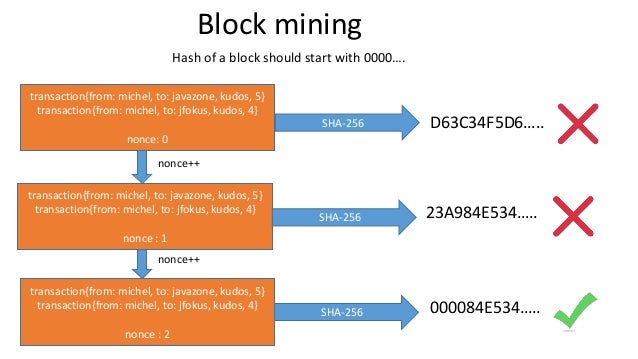
Nonces are used in proof-of-work systems to vary the input to a cryptographic hash function so as to obtain a hash for a certain input that fulfills certain arbitrary conditions. In doing so, it becomes far more difficult to create a 'desirable' hash than to verify it, shifting the burden of work onto one side of a transaction or system. For example, proof of work, using hash functions, was considered as a means to combat email spam by forcing email senders to find a hash value for the email (which included a timestamp to prevent pre-computation of useful hashes for later use) that had an arbitrary number of leading zeroes, by hashing the same input with a large number of values until a 'desirable' hash was obtained.
Similarly, the bitcoinblockchain hashing algorithm can be tuned to an arbitrary difficulty by changing the required minimum/maximum value of the hash so that the number of bitcoins awarded for new blocks does not increase linearly with increased network computation power as new users join. This is likewise achieved by forcing bitcoin miners to add nonce values to the value being hashed to change the hash algorithm output. Because cryptographic hash algorithms cannot easily be predicted based on their inputs, this makes the act of blockchain hashing and the possibility of being awarded bitcoins something of a lottery, where the first 'miner' to find a nonce that delivers a desirable hash is awarded bitcoins.
Generate Key With Nonce Java Code
See also[edit]
References[edit]
External links[edit]
Generate Key With Nonce Java Pdf
- RFC2617 – HTTP Authentication: Basic and Digest Access Authentication
- RFC3540 – Robust Explicit Congestion Notification (ECN) Signaling with Nonces
- RFC4418 – UMAC: Message Authentication Code using Universal Hashing